
What Is a Dynamic EQ? (And How to Tame Bass and Vocals With One)
By Omar Meho, 13 November 2026
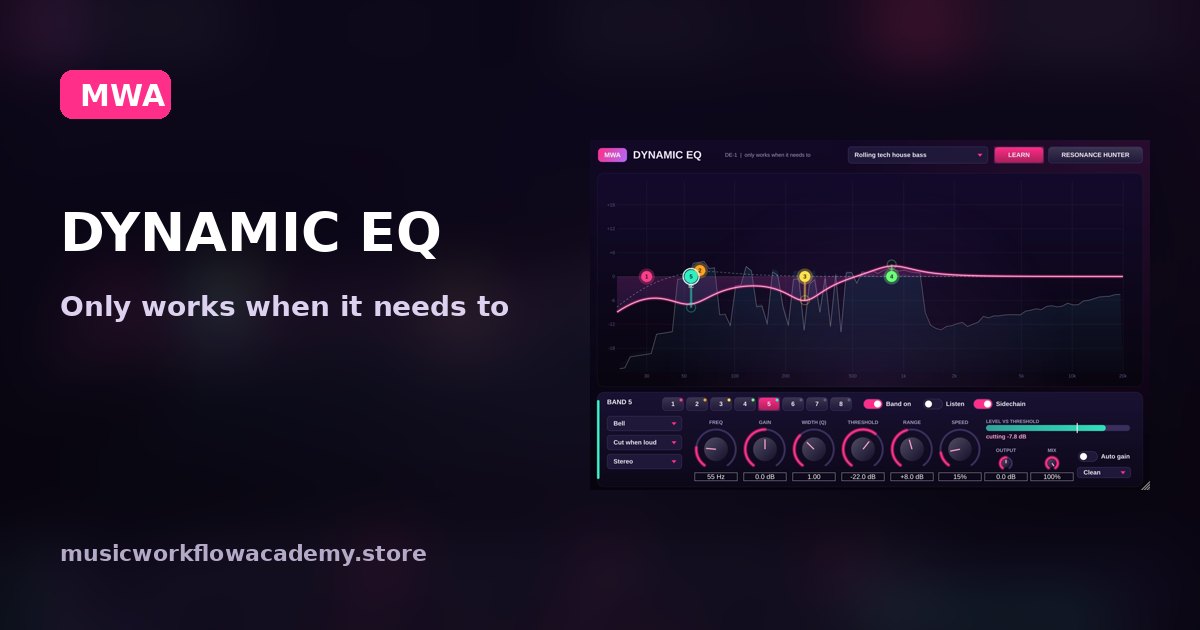
A normal EQ cuts all the time. A dynamic EQ only cuts when the problem actually shows up. That one difference fixes harsh vocals and muddy basses without making them sound thin.
Normal EQ vs dynamic EQ
Say your vocal gets harsh on a few loud words. A normal EQ cut at 3 kHz fixes those words but dulls every other word too. A dynamic EQ band only cuts when 3 kHz goes over a threshold. Quiet words stay bright, loud words get tamed.
Think of it as a compressor that only listens to one slice of the sound.
Three jobs it does better than anything else
- De-essing: a high shelf that only cuts when an S or T hits.
- Kick and bass carving: a band on the bass that dips around 60 Hz only when the kick plays, using the kick as a sidechain.
- Resonances: a narrow notch that only bites when a note rings out.
How to set one up
- Find the problem: sweep a narrow boost until the bad bit jumps out, then set the band there.
- Set the threshold just under the level where the problem starts.
- Set the range, the most it is allowed to cut. Start at 3 to 6 dB.
- Set the speed: fast for esses and kicks, slower for boomy notes.
MWA Dynamic EQ
I built MWA Dynamic EQ to make those steps quicker. Press LEARN while your loudest part plays and every band gets its threshold in 4 seconds. RESONANCE HUNTER finds ringing frequencies for you. Any band can listen to a sidechain, and every band works in stereo, mid or side.
It comes with 15 presets: tech house, Reese, 808, garage organ, acid and wobble basses, five vocal presets, plus a mix bus and drum bus preset. Mac (AU and VST3), £49, and included in the MWA Bundle.